Every rail joint is a point where the track behaves differently from the rail either side of it. Flash butt welding removes that discontinuity by fusing two rail ends into one continuous piece of steel. It does this using electrical current and mechanical force, with no added filler metal.
This article explains the rail welding process step by step, why the method is widely used for continuous welded rail, and what quality checks follow a weld. It is written for engineers, contractors and procurement teams who want a clear view of what happens between the rail ends and the finished joint.
Why rails are welded at all
Traditional fishplated rail joints have bolted connections and a small gap between rail ends. Wheels strike that gap, and the impact loads the rail ends, fastenings, sleepers and ballast. The result is more wear, more geometry deterioration and more maintenance in the joint area. Rail joints are also a common source of noise and vibration.
Welding rails into long lengths reduces the number of joints in the track. This is the basis of continuous welded rail (CWR), where rails are welded into long strings and fixed to the sleepers. Fewer joints generally means a smoother ride and less maintenance effort at joint locations. CWR does need careful management of temperature-related forces, which we cover below.
What flash butt welding is
Flash butt welding is a form of resistance welding. Two rail ends are clamped in a welding machine, a high electrical current is passed through the contact area, and the ends are then forced together. The steel is heated to a plastic state at the interface, not melted through the full section, and the two rails are forged into one.
Because no filler material is used, the weld is made from the parent rail steel itself. This is one reason the method is valued for consistency: the process is largely controlled by the machine, so results depend less on the manual skill applied during the weld itself. Good preparation and correct set-up still matter a great deal.
The rail welding process, step by step
1. Preparation and alignment
The rail ends are inspected and cleaned where the electrodes will contact the rail. Ends should be cut square and free of damage. The rails are then positioned in the machine and clamped, with the profile and running surfaces aligned vertically and horizontally. Poor alignment at this stage is hard to correct later, so it deserves attention.
2. Flashing
Current is applied while the rail ends are brought close together. Contact between the uneven end faces creates small points of high resistance, which heat rapidly and produce the sparks that give the process its name. This flashing stage heats the rail ends progressively and burns away surface irregularities, so that the faces become uniformly hot.
3. Upsetting (forging)
Once the ends reach the correct condition, the machine rapidly pushes the rails together under high force. This upset expels oxides and impurities from the interface and forms the weld. A ring of displaced hot metal, often called upset metal or flash, is pushed out around the joint.
4. Trimming
While the weld is still hot, the machine shears off the excess upset metal around the rail section. This leaves the joint close to the rail profile and ready for finishing.
5. Finishing and heat treatment
The weld zone is ground to restore the correct rail profile and a smooth running surface. Depending on the rail grade and the railway's requirements, controlled cooling or post-weld heat treatment may be specified to manage the hardness and microstructure of the weld zone. The specification set by the infrastructure owner decides what applies.
Welding in a plant and welding in the track
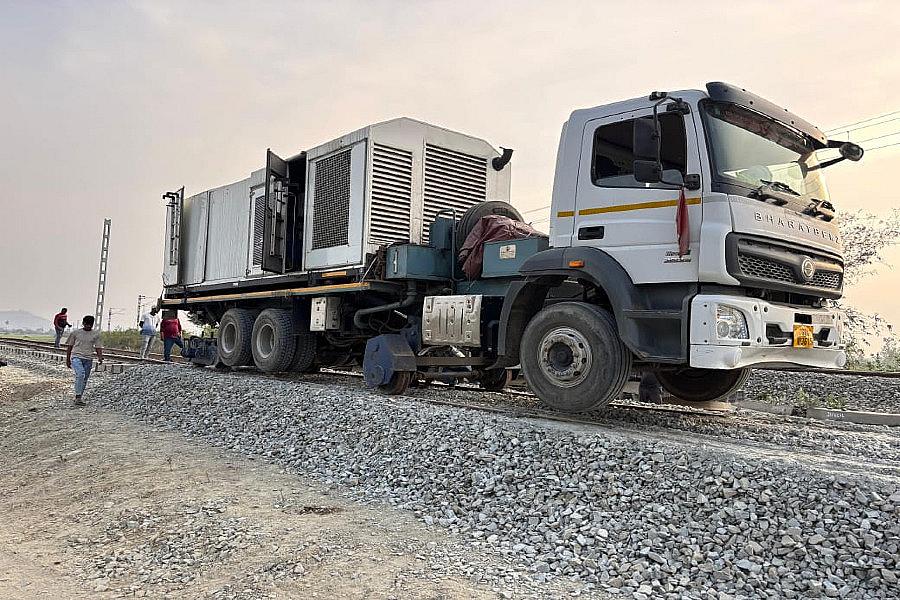
Flash butt welding is used in two main settings. In a fixed plant, short rails are welded into long panels, which are then transported to site. Mobile flash butt welding takes the machine to the track, usually mounted on a road-rail vehicle or similar carrier, so that rails can be welded where they lie.
Mobile welding is useful for joining panels together, replacing defective sections and closing gaps without bringing rails back to a depot. It does depend on track access, power supply on the machine, site preparation and planning of possession time. For more on how this fits into track work, see our services and technology pages.
Quality control and testing after welding
A completed weld is not accepted on appearance alone. Typical checks include:
Visual inspection of the weld zone and finished profile.
Geometry checks with a straightedge or similar tool, to confirm vertical and lateral alignment.
Ultrasonic testing to detect internal flaws that cannot be seen on the surface.
Process records from the welding machine, which show whether the weld cycle stayed within set parameters.
Acceptance criteria and test frequency come from the railway's specification and applicable standards, and these vary between owners. Ultrasonic testing is also used later in service, as part of routine rail inspection, to monitor weld condition over time.
Managing continuous welded rail in service
Welding removes the expansion gaps that fishplated joints provide, so steel in CWR cannot lengthen or shorten freely as temperature changes. Instead, stresses build up in the rail. In hot weather the rail is in compression and can buckle if track resistance is insufficient. In cold weather it is in tension, which can contribute to rail breaks at defects or poor welds.
To manage this, CWR is normally laid and fastened within a planned temperature range, often described as the rail neutral or stress-free temperature, and track is supported by adequate ballast and fastenings. Well-made welds matter here because a weld defect in tensioned rail is a point of weakness. Stress adjustment and maintenance work should follow the railway's own procedures.
Frequently asked questions
Is flash butt welding the same as thermite welding?
No. Thermite welding pours molten steel from a chemical reaction into a mould around the rail ends. Flash butt welding uses electrical heating and forging pressure with no added metal. Each has uses, and the choice depends on access, equipment and the railway's requirements.
Can flash butt welding be done on site?
Yes, with mobile equipment designed for in-track work. It needs suitable access, a clear work area and planned track possession. Some work is better suited to a fixed plant, so the choice should be made at planning stage.
How are flash butt welds checked?
Welds are normally checked visually, for geometry and with ultrasonic testing, alongside the machine's process records. The exact scope depends on the specification that applies to the project.
Does welding remove the need for track maintenance?
No. Welding reduces maintenance at joints, but track still needs inspection, geometry correction and rail testing. Welds should be monitored like any other part of the rail.
Conclusion
Flash butt welding joins rails by combining controlled heating, forging pressure and finishing, and it is a core method behind continuous welded rail. The outcome depends on preparation, alignment, process control and testing, not on the welding stage alone.
If you are planning rail welding or testing work and want to discuss your requirements, you are welcome to contact RTIW. You can also read more about our services and technology.